Catalyzing innovation and scale of alternative proteins.
Pooled philanthropic capital to advance the science, policy, and markets for plant-based, fermented, and cultivated meat and dairy.
The Impact Opportunity
-

Climate
Alternative proteins can help reduce food-system greenhouse gas emissions, including methane. Food systems account for roughly one-third of global GHG emissions, with livestock production contributing a significant share. Developing and adopting new protein sources is a key strategy for reducing global emissions.
-

Biodiversity & Land Use
More land-efficient proteins can reduce pressure on land and ecosystems. Livestock production uses most of the world’s agricultural land and is a major driver of habitat conversion and biodiversity loss. Shifting protein production can create more space for conservation, ecological restoration, and regenerative and agroecological approaches to agriculture.
-

Water
Non-animal-derived proteins can reduce pressure on freshwater resources and water quality. Livestock production has a substantial water footprint and is a major contributor to nutrient pollution. More resource-efficient proteins can help reduce these pressures and contribute to bringing food production back within Earth’s ecological limits.
-

Animal Welfare
Alternative proteins can meet growing demand while reducing reliance on animals for food. Tens of billions of land animals—and far more aquatic animals—are raised and killed for food each year. Expanding alternative protein options can significantly reduce the number of animals used in food production and the negative welfare impacts associated with industrial animal agriculture.
How We Work
Barriers to scaling alternative proteins cannot be solved by companies or markets alone.
Our approach is landscape-driven: we identify critical gaps, determine where philanthropy can be most catalytic, and direct funding toward opportunities that can unlock progress across the broader ecosystem.
Barriers to scaling alternative proteins cannot be solved by companies or markets alone.
Our approach is landscape-driven: we identify critical gaps, determine where philanthropy can be most catalytic, and direct funding toward opportunities that can unlock progress across the broader ecosystem.
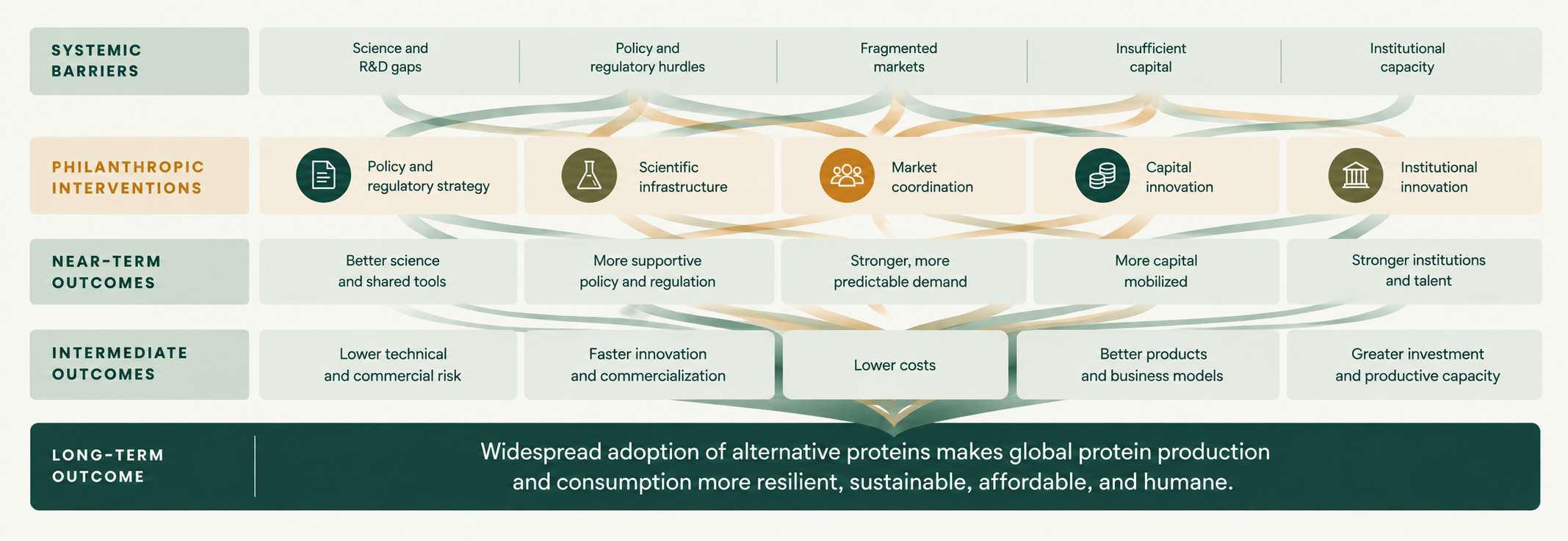
How We Work
WE ADDRESS SYSTEMIC BARRIERS
Science and R&D gaps · Policy and regulatory hurdles · Fragmented markets · Insufficient capital · Institutional capacity
THROUGH CATALYTIC PHILANTHROPY
Policy and regulatory strategy · Scientific infrastructure · Market coordination · Capital innovation · Institutional innovation
TO UNLOCK PROGRESS
Better science and shared tools · More supportive policy and regulation · Stronger demand · More capital · Stronger institutions
AND DRIVE TRANSFORMATION
Lower technical and commercial risk · Faster innovation and commercialization · Lower costs · Better products and business models · Greater investment and productive capacity
LONG-TERM OUTCOME:
Broad adoption of alternative proteins accelerates the transition to a more resilient, sustainable, and humane global food system.
Interested in the Future Protein Fund?
We welcome conversations with funders and partners interested in advancing a more sustainable global protein system.
Supporting Partners


Launching October 2026.
The Future Protein Fund is a program of Food System Innovations, a registered 501(c)(3) nonprofit organization.